Immersia POS
The operating system for a games arcade — tills, queues, PC assignment, and a loss-prevention layer that reconciles camera counts against the till.
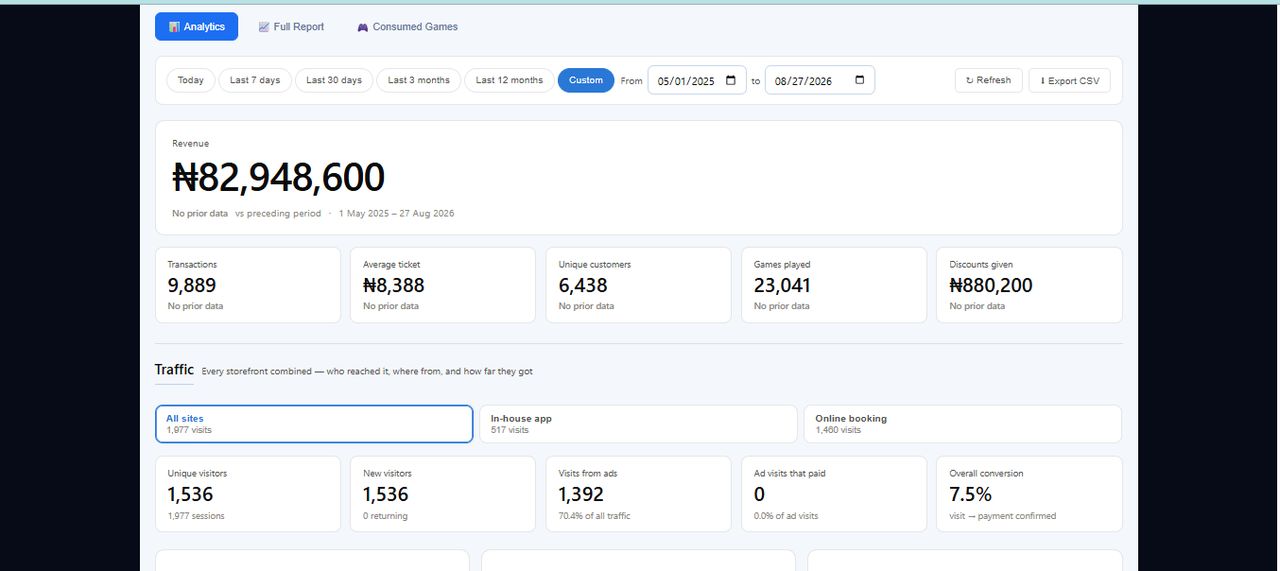
An arcade loses money in a dozen quiet ways: a session that never got rung up, a drink off the shelf, a PC unlocked as a favour. Immersia POS closes those gaps. It runs the floor — game selection, the operator queue, PC lock and release, tickets, drinks — and then it runs the audit on top, because the hard part of a venue business is not taking payment, it is knowing that everything taken was recorded. It has been running the floor since May 2025 and has processed just under ₦83m in that time.
The twelve modules
- PC Control — lock or unlock machines and watch live status across the floor.
- Operator Queue — verify payment, then assign the customer to an available PC.
- Bypass Logs — every emergency override recorded and reviewable.
- Games — catalogue, pricing and time slots.
- Drinks — stock levels and inventory updates.
- Reports — analytics plus sales, customer and consumed-game reporting.
- Admins — accounts and per-role permissions; the console shows only what your role owns.
- Manual Transaction — manual and split transactions recorded from the desk.
- Internal Control — Entry — camera-review counts filed by station, editable for 24 hours.
- Internal Control — Review — recorded counts compared against actual sales, colour-coded by variance.
- Table Tennis Score — live scoring that customers watch on a public scoreboard.
- Credit Report — outstanding balances tracked and cleared when customers pay.
Live since 1 May 2025: ₦82,948,600 processed across 9,889 transactions and 6,438 unique customers, 23,041 games played, at an ₦8,388 average ticket. Five of the twelve modules exist purely for loss prevention — camera-verified counts, a 24-hour edit window, colour-coded variance review, an audited bypass trail and credit tracking. That reconciliation loop is the hardest thing in this portfolio to copy.